According to Chinese folklore, the Pixiu has a great appetite for gold and no way of letting any of it go. On a bracelet it appears as a stocky, lion-like creature with a curling mane, a wide mouth and a round, well-fed belly. Sometimes it crouches on a heap of coins; sometimes small wings curl at its shoulders. It manages to look fierce and faintly comic at the same time, which suits its story rather well.
The Pixiu (貔貅, also written Pi Xiu and known as Pi Yao) is one of the oldest creatures in Chinese legend. Long before it sat on a bracelet, its name was carried on army banners and its winged relatives kept watch over the tombs of the powerful. Today it is Feng Shui’s best-loved guardian of wealth.
This guide follows it from legend to wrist: where it comes from, why it is said to swallow but never let go, and how it is traditionally worn, with an honest word on what a symbol can and cannot do.
From army banners to tomb guardians
The Book of Rites (Liji), a classic compiled more than two thousand years ago, describes the banners raised at the head of an army on the march: one signalled water ahead, another dust on the road, and when fierce beasts lay ahead, the Pixiu banner went up. Over time the name came to stand for courage, and it appeared on war flags as an emblem of brave soldiers.
By the Han dynasty, carved winged beasts of the same family were standing guard at the tombs of emperors and nobles. Around Nanjing, great stone beasts carved roughly 1,500 years ago for the tombs of the Southern Dynasties still keep watch over the old spirit roads. One of them, the bixie, has become an emblem of the city.
The names vary. One long-standing distinction calls the one-horned form tianlu, linked with heavenly blessing and wealth, and the two-horned form bixie, whose name means “to ward off evil”, though sources do not always agree. Another popular explanation says pi is the male and xiu the female, which is one reason Pixiu are so often made in pairs. Most modern Pixiu have a single horn.
Why the Pixiu only takes in: a tale from the Heavenly Court
Every tradition has a few stories told with a grin, and this is one of them. In the best-known folk version, the Pixiu lived in Heaven on a diet of gold, silver and jewels. One day it forgot its manners and relieved itself in the Heavenly Court. The Jade Emperor, ruler of Heaven, was not amused. He gave it a smack on the rump hard enough to seal it shut for good.
From then on the Pixiu could swallow treasure but never pass any of it out again. Whatever went in stayed in. Another telling makes the Pixiu a son of the Dragon King, sealed up in the same way as punishment for a different misdeed. The details vary; the point does not.
That is why the Pixiu is known as the creature that “only takes in and never lets out”. In Feng Shui practice it is said to draw wealth towards its owner and keep it there, while its fierce face, the bixie side of its nature, is said to devour ill fortune as readily as gold. Read as a reminder rather than a spell, it is surprisingly practical advice: notice what comes your way, and don’t let it slip through your fingers.
How a Pixiu is traditionally worn and kept
There is no single rulebook. Customs differ between families, regions and Feng Shui teachers, so these are the points most widely shared.
On the left wrist, head facing out
A common Feng Shui saying is “left in, right out”: the left hand is the receiving side. So a Pixiu bracelet or ring is usually worn on the left. The Pixiu’s head should face outward, towards your little finger and the world beyond, rather than up your arm towards you. The idea is that it gathers from the world around you, not from you.
Yours alone
Folk belief holds that a Pixiu attaches itself to one owner, so many people prefer not to let others handle theirs. Touching its eyes and mouth casually is avoided too. Some owners take a new Pixiu to a temple for kaiguang (開光), a consecration rite whose name means “opening the light”; others put it on with a clear intention and leave it at that. Both are part of a living practice.
When to take it off
Traditionally a Pixiu comes off for bathing, for sleep and for intimate moments, and rests in its own box or pouch when you are not wearing it. That is good sense, too: soap, water and knocks are hard on stone, plating and cord, as our jewellery care guide explains.
At home or at work
Pixiu figures are kept in a living room, study or office rather than a bedroom, usually with the head facing a window or doorway so it looks out towards whatever is coming in, and not towards a mirror or a bed.
Why Pixiu and obsidian are such a familiar pair
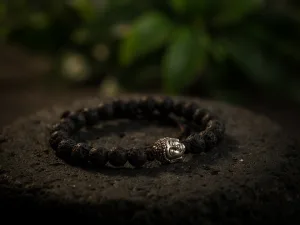
Browse Pixiu bracelets and you will notice how often the beads are black. Obsidian is traditionally worn as a grounding, protective stone, and set beside a Pixiu it completes a neat idea: the Pixiu gathers, the obsidian guards. Our guide to choosing a stone by intention looks at obsidian itself in more detail, alongside tiger’s eye and jade.
To be clear, the pairing is a modern favourite rather than an ancient rule. You won’t find it in the classics. It grew out of contemporary practice because the two meanings sit comfortably together, and because a carved black Pixiu among dark, polished beads is a handsome thing.
The stone comes in several looks. Plain black obsidian is glossy and deep; golden obsidian shows a warm sheen as light moves across it; rainbow obsidian reveals soft bands of colour at certain angles. Some bracelets carry a Pixiu carved from the stone itself, like this golden obsidian double Pixiu bracelet; others set a gold-toned or silver Pixiu among black beads. You can see the full range in our Obsidian collection.
Choosing a Pixiu: materials, colours and pairs
A Pixiu means the same thing whatever it is made from, but each material adds associations of its own.
- Gold-toned Pixiu echo the treasure of the legend and are the classic look for a wealth charm.
- Silver is valued in Chinese and Buddhist tradition for its purity, and gives a quieter, cooler look.
- Jade brings its own long tradition in China as a wish for harmony and a long life, and joins those wishes to the Pixiu’s.
- Cinnabar, with its deep vermilion red, is treasured in Chinese tradition as the colour of life force and good fortune.
- Citrine, known as the merchant’s stone, and tiger’s eye, traditionally worn for courage, are popular companions when you want warmth or confidence as well.
One Pixiu or two? A single Pixiu is a personal guardian. A double Pixiu bracelet recalls the old idea of a male and female pair, often read as balance. Neither is more correct.
Beyond that, look at the face: a well-carved Pixiu has a lively expression, and it is the part you will glance at most. Choose a size you will actually wear. A Pixiu left in a drawer keeps nothing.
Frequently asked questions
Which wrist should I wear a Pixiu bracelet on?
Most Feng Shui guidance says the left, following “left in, right out”, with the Pixiu’s head facing towards your little finger. Some practitioners make an exception for black obsidian Pixiu and say they may be worn on the right. If you do wear yours on the right, keep the head facing outward.
Can other people touch my Pixiu?
Traditionally, no. A Pixiu is regarded as bonded to its owner, so it is kept for your hands alone. One given as a gift becomes the recipient’s own.
Are Pixiu and Pi Yao the same thing?
Yes. Pi Yao is another name for the same creature, and you may also meet the older names tianlu and bixie.
Will a Pixiu make me wealthy?
No piece of jewellery can promise that, and we would never claim one does. What a Pixiu can do is sit on your wrist as a steady prompt: to notice opportunities, to work at them with care, and to look after what you earn. Many people find that kind of reminder useful.
The Pixiu has marched on army banners and guarded emperors’ tombs; these days it keeps company with a great many wrists. Whether you are drawn to its legend, its looks or the daily nudge it gives towards good habits, choose one that feels like yours. Our Pixiu collection is a good place to start.
Share this article
Shop the meaning
Wear what it means to you
Every piece in our collections is sorted by the intention, symbol and stone it carries, with the meaning explained in plain words.
Keep Reading
Meanings & Symbols
Meanings & Symbols
Meanings & Symbols