Walk through an old quarter of Istanbul or along a Greek island harbour and you will be watched from every direction: by blue glass eyes hanging in doorways, swinging from taxi mirrors and pinned to babies’ clothes. Close by you will often find a second figure, an open hand with an eye set in its palm.
The evil eye and the hamsa are two of the oldest protective symbols still in everyday use. Neither comes from Buddhism, and we want to say so plainly. They sit in our collection because they share a wish that runs through much of it: to feel looked after as you go about your day. Below we look at where each comes from, what it means to the communities that keep it, and how both are traditionally worn.
What the “evil eye” actually is
The evil eye is not the amulet. It is the thing the amulet guards against. The belief is that a look charged with envy, or even with too much admiration, can bring misfortune to whoever receives it. In many tellings the person who casts it means no harm at all. A neighbour admires your new baby a little too long, and that is enough.
The idea is very old. Texts from Ugarit, an ancient port city in what is now Syria, already refer to it, and Plutarch puzzled over how a mere glance could do harm in his Table Talk. The Romans spoke of fascinatio, bewitchment, and the same Latin root gives English the word “fascinate”.
Today the belief reaches from the Mediterranean through the Middle East to South Asia, and on to Latin America as mal de ojo. Many languages keep a verbal shield against it. Turkish speakers add maşallah (“God has willed it”) or nazar değmesin (“may the eye not touch it”) to a compliment. Yiddish speakers say keyn eyn-hore, “no evil eye”, and Greeks may follow praise with a soft “ftou ftou”, a polite pretend spit.
The blue glass eye: nazar and mati
The amulet most people picture is the Turkish nazar boncuğu. Nazar comes from the Arabic for sight or a look, and boncuk means bead. In Greece the same charm is called máti, “eye”. In its classic form it is handmade glass in concentric rings: deep blue, then white, then pale blue, with a black centre. The logic is direct: the bead is an eye that looks back, turning a harmful glance aside.
In Turkey the craft is closely linked with two villages in İzmir province, near the Aegean coast: Görece, and Kurudere, better known as Nazarköy, “evil eye village”, where glassmakers still make the beads by hand.
Why blue? Nobody knows for certain. One answer is that blue has long been treated as a protective colour in the region. Another is that light eyes were rare around the eastern Mediterranean, so a blue-eyed stranger’s stare was the one to fear, and the amulet answers it in kind. Both are folk explanations rather than settled history.
The hamsa: one hand, many names
The hamsa is an open hand, often drawn symmetrically with a thumb on each side. Its name comes from the Arabic khamsa, “five”, for the five fingers; the Hebrew hamesh means the same. Open-hand motifs appear across the ancient Near East and North Africa, including at Carthage in present-day Tunisia, and scholars still debate exactly where the hamsa began. Muslim, Jewish and Christian communities all took it up.
- In Muslim communities, especially across North Africa, it is linked with Fatima, daughter of the Prophet Muhammad. The English name “Hand of Fatima” was largely popularised by Europeans; in Arabic it is usually just the khamsa. Some Shia Muslims read the five fingers as the five People of the Cloak: the Prophet, Fatima, Ali, Hasan and Husayn.
- In Jewish communities, particularly Sephardi and Mizrahi families, it is often called the Hand of Miriam, after the sister of Moses and Aaron, and appears on jewellery, wall hangings and even decorated marriage contracts.
- Among Christians of the Levant it is sometimes known as the Hand of Mary.
In each of these faiths some religious authorities have been wary of amulets, and for many families the hamsa is a matter of heritage and folk custom rather than doctrine.
You will see the hand both ways up. A common reading holds that fingers pointing up guard against harm, while fingers pointing down offer blessing and welcome. Readings vary from place to place.
Eye, hand and colour: how they are combined
Many hamsas carry an eye in the palm, and the pairing makes sense: the hand holds trouble back, the eye watches for it. An Arabic saying, khamsa fi ainek, “five in your eye”, captures the same gesture of pushing a jealous glance away.
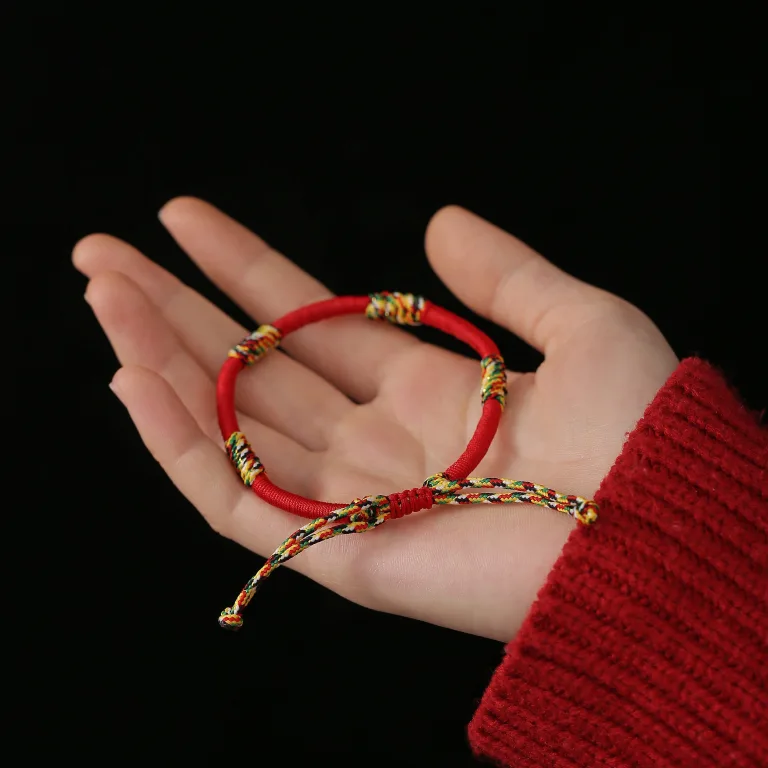
The two are often set in silver or threaded onto a red cord. In Jewish folk custom red and blue are both said to turn the evil eye aside, which helps explain why a blue eye on a red string is such a familiar sight. Our Hamsa Hand Red String Bracelet brings hand, eye and thread together in just this way. The red thread has stories of its own across several faiths, told in our guide to the red string bracelet.
Dark blue is the classic colour. Today you will also find turquoise, green, red, pink and gold eyes, often sold with charts giving each colour its own meaning. Those charts are a modern addition and differ from one maker to the next, so choose the shade you will be glad to see every day.
How they are traditionally worn, hung and replaced
- On the body. Bracelets, necklaces and earrings are the everyday choice. Many people like the eye to face outwards, towards the world.
- For babies. Newborns are thought to be especially exposed to admiring looks, so in Turkey a small bead is often pinned to a baby’s clothes, and nazar charms are a favourite gift for a new baby.
- At home and on the road. A larger eye or hamsa hangs by the front door, where visitors and their glances arrive; shops and cars often have one too.
If a bead cracks
Sooner or later a glass eye will crack. In folk belief this is not bad luck. It means the bead has done its work, taking in a stronger look than usual so that you did not have to. The custom is to replace it rather than mend it. Some people bury the old bead or let it go with a word of thanks; there is no single rule. If you prefer a practical reading, glass meets door frames and enamel chips with wear; either way, a fresh eye is easily put back.
Not Buddhist, but close in spirit
If you come to these symbols from Buddhist practice, two ideas sit naturally beside them.
The first is visual. In Buddhist and Hindu art, a raised right hand with the palm facing outward is the abhaya mudra, the gesture of fearlessness and reassurance. Its history is separate from the hamsa, yet the meaning rhymes: an open hand that says you are safe here.
The second goes to the root of the belief. If the evil eye is envy given a face, Buddhist teaching offers mudita, sympathetic joy, one of the four brahmaviharas, traditionally practised as the antidote to envy. A blue eye on the wrist can work in both directions: as a wish to be sheltered from ill will, and as a nudge to meet other people’s good fortune with gladness rather than comparison.
Frequently asked questions
Can anyone wear an evil eye or a hamsa?
Yes. Both are folk symbols shared across many cultures and given freely as gifts. It is worth knowing a little of their story, and remembering that for many families the hamsa carries real religious feeling.
Which way up should a hamsa be worn?
Either. Fingers up is usually read as protective and fingers down as a blessing; wear it the way that means most to you.
Is it bad luck to buy an evil eye for yourself?
No tradition we know of forbids it. Nazar beads are very often given as gifts, especially for new babies, but plenty of people buy one for themselves.
Is the evil eye a religious symbol?
The belief appears in Jewish, Christian and Islamic writings, but the blue bead is a folk amulet rather than the emblem of any one religion. Some religious teachers discourage amulets; many believers keep them as a cherished custom.
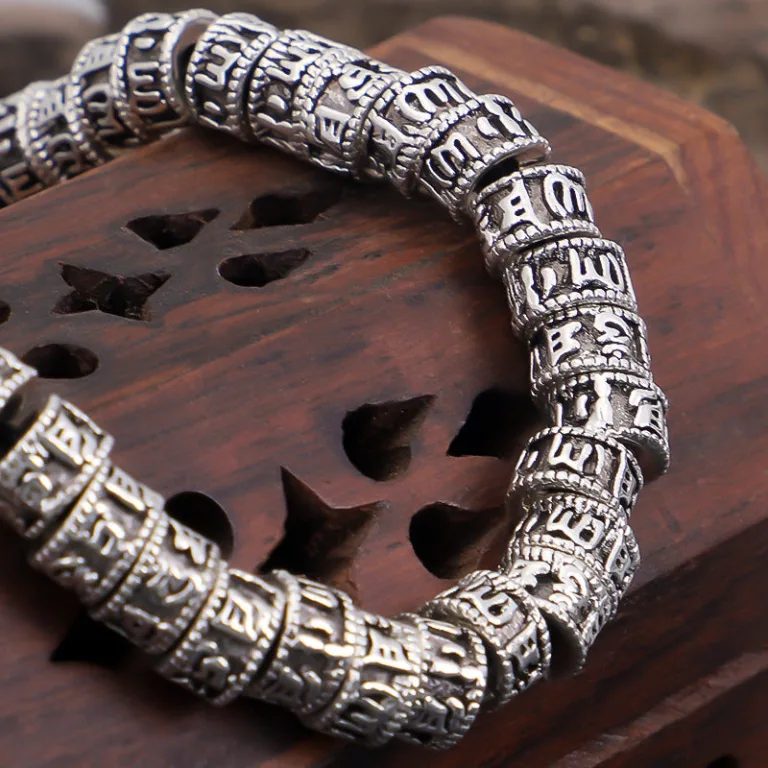
If one of these old watchers feels right for you, you will find blue eyes and open hands in our Evil Eye & Hamsa collection, and other traditional guardians, from obsidian to mantra bracelets, in our Protection collection. Wear it as a bright reminder that you are looked after, and that you can look kindly on others in return.
Share this article
Shop the meaning
Wear what it means to you
Every piece in our collections is sorted by the intention, symbol and stone it carries, with the meaning explained in plain words.
Keep Reading

Meanings & Symbols
Meanings & Symbols
Meanings & Symbols