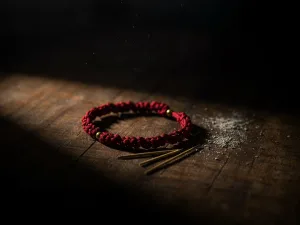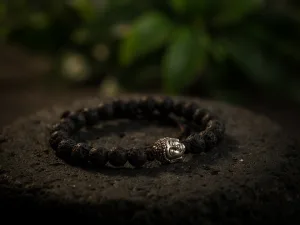
The raised lettering on a Tibetan-style mantra bracelet is not a pattern. It is writing. Most often it is the six-syllable mantra Om Mani Padme Hum. On some rings it is the Heart Sutra, engraved in tiny Chinese characters around the band.
These are two of the best-loved texts in Buddhism, and they share an unexpected thread: both are tied to Avalokiteshvara, the bodhisattva of compassion. This guide explains what the words say, how they are traditionally used, and how to wear them with care.
Om Mani Padme Hum: six syllables of compassion
Om Mani Padme Hum is the best-known mantra in Tibetan Buddhism. Its earliest known source is the Karandavyuha Sutra, a Mahayana text usually dated to around the fourth or fifth century CE, which describes it as the “innermost heart” of Avalokiteshvara.
Avalokiteshvara embodies the compassion of all the buddhas. In Tibet he is known as Chenrezig, and the Dalai Lamas are regarded in Tibetan tradition as his emanations. In China and across East Asia the same bodhisattva is honoured as Guanyin, usually in female form. Many Tibetans pronounce the mantra closer to Om mani peme hung, softening the original Sanskrit sounds.
Word by word, mani means “jewel” and padme comes from padma, “lotus”, hence the familiar translation “the jewel in the lotus”. Scholars are less certain: the grammar can be read in more than one way, and some argue that “jewel-lotus” is itself a name for Avalokiteshvara. Tibetan teachers rarely treat a mantra as a sentence to be translated, though. Its meaning lives in the teachings around it. One widely shared explanation comes from the 14th Dalai Lama:
- Om stands for body, speech and mind: our ordinary ones and the pure body, speech and mind of a buddha.
- Mani, the jewel, stands for method: the altruistic intention to awaken for the sake of others, compassion and love.
- Padme, the lotus, stands for wisdom.
- Hum stands for method and wisdom held together as one.
Read this way, the six syllables describe a path: by joining compassion with wisdom, ordinary body, speech and mind can be transformed. Other teachers link the syllables to the six perfections (generosity, ethical conduct, patience, effort, concentration and wisdom) or to the six realms of existence.
Spoken, carved and spun: how the mantra is used
Most simply, the mantra is said: aloud, under the breath while walking or working, or counted on prayer beads. The Dalai Lama has encouraged those who recite it to reflect on its meaning as well.
Across the Himalayan world it is also carved into mani stones set beside paths and stacked into long walls, painted on rock faces and printed on prayer flags. And it is spun. A prayer wheel is a cylinder holding a long strip of paper printed with the mantra many times over, wound around a central axle. Turning it is traditionally said to carry much the same merit as reciting the words inside, and many people recite as they turn. Wheels are turned clockwise, the direction in which the mantra is written and the sun crosses the sky. Some fit in one hand; others stand taller than a person, or line monastery walls in rows that pilgrims set turning as they walk around.
Jewellery echoes these uses. A bracelet of beads engraved with the six syllables is a little like a mani stone you can wear, and a pendant made like a small prayer wheel turns between your fingers. Neither replaces practice, but either can become a cue to stop, breathe and think of someone kindly.
The Heart Sutra: a whole teaching in a few lines
The Heart Sutra, in Sanskrit Prajnaparamita Hridaya, “the Heart of the Perfection of Wisdom”, is famous for its brevity. The standard Chinese version, traditionally attributed to the seventh-century monk and translator Xuanzang, runs to about 260 characters, short enough to be engraved inside a ring band. It is chanted daily in temples across East Asia (in Japan as the Hannya Shingyō) and studied and recited in Tibetan Buddhism too.
Its speaker is, once again, Avalokiteshvara. Deep in the practice of wisdom, the bodhisattva sees that the five aggregates that make up a person (form, feeling, perception, mental formations and consciousness) are all empty, and through that insight passes beyond suffering. He explains this to Shariputra, one of the Buddha’s foremost disciples, in the sutra’s best-known line:
Form is emptiness, emptiness is form.
“Emptiness” here does not mean nothingness. It means that nothing exists entirely by itself. A cup of tea depends on leaves, water, soil, rain, sunlight and the hands that picked and brewed it; take those away and there is no separate “tea” left over. The Vietnamese Zen teacher Thich Nhat Hanh put it in a phrase: things are empty of a separate self.
The second half of the line matters just as much. Emptiness is form: this changing, interdependent world is not something to escape. It is where life and practice happen. For many readers the sutra is also a teaching on letting go. If nothing is fixed, neither are our worries, the labels we give ourselves or our certainty about how things must turn out.
Gate gate paragate: the mantra at the end
The sutra calls the perfection of wisdom the greatest of mantras, then closes with a mantra of its own:
Gate gate paragate parasamgate bodhi svaha
A common English rendering is “gone, gone, gone beyond, gone altogether beyond: awakening, so be it”. The image is of crossing a river. Para is the far shore, and the perfection of wisdom is traditionally explained as wisdom that has gone across, from confusion to awakening. Svaha is a glad exclamation that ends many mantras. Some modern translators prefer “arriving, arriving”, to suggest that the crossing is happening now.
In Chinese versions, including those engraved inside rings, the mantra is written by sound rather than translated, so the Sanskrit syllables are kept.
Wearing sacred words with respect
You do not need to be Buddhist to wear a mantra bracelet or a Heart Sutra ring. But these are living scriptures for a great many people, and a little care is part of wearing them well:
- Know what it says. A brief thought about compassion as you put the piece on keeps the meaning alive.
- Keep it above the waist. In many Asian cultures the feet and lower body are regarded as the least clean part of the body, so sacred script is usually worn at the wrist, finger or neck, not on an anklet, a toe ring or in a back pocket.
- Set it down somewhere clean and raised. Buddhist centres ask that Dharma texts are kept off the floor and never stepped over. A small dish on a shelf or a corner of a home altar extends the same courtesy to jewellery.
- Let it prompt you. Turning a mantra bead can mark a pause: one breath, one kind thought, one line of the sutra remembered.
- Retire it thoughtfully. Tibetan Buddhist custom is to burn worn-out paper scriptures respectfully rather than throw them away. A broken piece of mantra jewellery can be kept, passed on, or taken to a local temple to ask what they suggest.
Customs vary between communities, and if you follow a particular tradition, your own teacher’s guidance comes first.
Frequently asked questions
Can someone who isn’t Buddhist wear Om Mani Padme Hum?
There is no rule against it, and many people who are not Buddhist wear mantra jewellery. What matters is the spirit in which it is worn: as a reminder of compassion, kept on the upper body and treated with care.
What script is the mantra written in?
On most Tibetan-style pieces it is Tibetan script. Some use Lantsa, an ornamental script used in Tibet for Sanskrit mantras. Heart Sutra rings are usually engraved in Chinese characters.
Does Om Mani Padme Hum really mean “the jewel in the lotus”?
That is the familiar translation, and mani and padme do mean jewel and lotus. Scholars still debate the grammar, and Tibetan teachers tend to explain the mantra through its symbolism: the jewel for compassion, the lotus for wisdom. The lotus has a long history of meaning in Buddhism, which we explore in what the lotus symbolises.
What is the Heart Sutra about, in one sentence?
It teaches that nothing exists separately and on its own, and that seeing this clearly is the way beyond suffering.
Whether it is six syllables on a bracelet or a sutra hidden inside a ring, sacred text in jewellery is meant to stay close: something you can touch, turn and come back to on an ordinary day. If you would like to carry these words with you, take your time with our Mantras & Heart Sutra collection.
Share this article
Shop the meaning
Wear what it means to you
Every piece in our collections is sorted by the intention, symbol and stone it carries, with the meaning explained in plain words.
Keep Reading

Meanings & Symbols
Meanings & Symbols
Meanings & Symbols