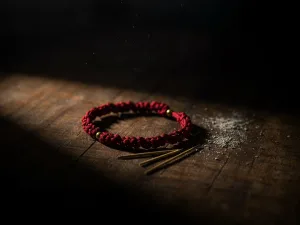
In a Hong Kong market, a Himalayan monastery, a Hindu temple courtyard or the lanes of Jerusalem’s Old City, you may notice the same thing on people’s wrists: a thin red cord, knotted and left to soften with time.
It looks like one custom, but it is several. The Chinese red thread speaks of luck and the bonds of fate. A Tibetan protection cord carries a teacher’s blessing. The Hindu kalava is tied at the start of worship, and a Jewish folk custom links a strand of red wool to the tomb of the matriarch Rachel. Each has its own story, its own way of tying, and its own sense of when the thread has done its work.
Knowing which story you are wearing makes the string mean more, so this guide takes each tradition in turn, then looks at how a string is tied and how it is retired.
Why red? A colour of life and good fortune
In Chinese culture, red is the colour of celebration. Brides wear it, families paste red couplets around their doors at the New Year, and money is given to children and newlyweds in red envelopes. It stands for life, warmth and good fortune, and a red thread at the wrist is the smallest, most personal way of carrying it.
Red matters most in your benmingnian, the year of your own zodiac animal, which comes round every twelve years. Folk custom treats this as a year that needs a little extra care, so people wear something red: a red belt, red socks, or a red string at the wrist, often given by family. If your own year is approaching, our Zodiac & Animal Year collection follows the same idea.
The Chinese red thread of fate
The most romantic red string is not worn on the wrist at all. In Chinese legend, Yue Lao, the Old Man Under the Moon, is the deity who arranges marriages. He ties a red cord around the ankles of two people destined for each other. The best-known telling comes from a Tang-dynasty tale in which a young man named Wei Gu finds an old man reading by moonlight, who shows him the red cords he uses to bind future husbands and wives. Later versions, like the Japanese akai ito, move the thread to the fingers. As the story is often retold today, the thread may stretch or tangle, but it never breaks.
Worn as a bracelet, the Chinese red string draws on all of this: luck, protection and the people you are bound to. In Feng Shui practice it is usually tied on the left wrist, thought of as the receiving side of the body. You will also hear the old saying nán zuǒ nǚ yòu, “men left, women right”, though few people treat it as a strict rule.
There is a seasonal cousin, too. At the Dragon Boat Festival, children traditionally have a five-colour thread tied around their wrists for protection. In many places it is cut off after the first rain that follows the festival and dropped into a river or stream to be carried away.
Tibetan Buddhist protection cords
In Tibetan Buddhism, a blessed cord is called a sungdü, meaning “protection knot”. Lamas give them at teachings, empowerments, the taking of vows and other important occasions. The teacher ties a knot in the cord, recites a mantra and blows gently onto the knot, which is where the blessing is said to rest. The cord may be placed around the neck or tied at the wrist. Red is common, but the colours vary.
Many practitioners see it less as a charm than as a way of carrying their teacher’s care and remembering the commitments they made that day. The blessing comes from the teacher and the occasion, not from the thread.
That is why a cord bought in a shop, ours included, is not a sungdü. A piece like our Tibetan-style red string bracelet borrows the look of these cords, and its multicoloured wraps recall the five colours of Tibetan prayer flags (blue, white, red, green and yellow), which are traditionally linked to the elements. It can carry meaning in the same spirit, but it has not been blessed by a lama, and we would not claim otherwise.
The Hindu kalava, or mauli
In Hindu worship, a sacred thread known as kalava, mauli or raksha sutra (“protective thread”) is tied around the wrist at a puja, a wedding or a festival. It is usually red, or red and yellow, and is tied by the priest or an elder of the family. A short Sanskrit verse recalling King Bali is often recited as it is tied, asking for the blessing of the deity being honoured.
Men usually wear it on the right wrist. For women the custom varies between regions and families, and many wear it on the left. The same idea of a thread as both a bond and a blessing appears at Raksha Bandhan, when sisters tie a rakhi on their brothers’ wrists.
The red string from Rachel’s Tomb
In Jewish folk custom, a red string is worn to guard against the evil eye. Its best-known source is the traditional tomb of Rachel, the biblical matriarch, on the edge of Bethlehem. Rachel, the beloved wife of Jacob, died giving birth to her second son, Benjamin, and the prophet Jeremiah describes her weeping for her children. She is remembered as a mother who prays for her people, and her tomb has long drawn pilgrims, particularly women hoping for children.
The custom is to wind a long red thread, traditionally wool, around the tomb, often seven times, and then cut it into wrist-length pieces. It is usually worn on the left wrist. The version popularised internationally by the Kabbalah Centre from the 1990s adds that it should be tied by someone who loves you, with seven knots, sometimes while a short prayer is said.
The custom is also debated. Winding thread at the tomb seems to have begun in the late nineteenth century, no Jewish law requires a red string, and some rabbis discourage it: the Tosefta, an early rabbinic text, lists tying a red thread around a finger among pagan customs. Others see it as a harmless folk practice. If you wear one, it is worth knowing both views.
Tying and removing a red string
Across these traditions, a few patterns stand out.
- Someone else usually ties it. A lama, a priest, an elder or a person who loves you. Tying one for a friend is a kind gesture in any tradition.
- The knot matters. In a Tibetan cord, the knot holds the blessing. Many people also set an intention or make a wish as each knot is tied; this is a personal custom rather than the rule of any one tradition.
Removal is guided by the same respect. The most common practice is to wear the string until it wears through and falls away. Folk belief says a string that breaks has done its work, though the plainer truth is that thread frays. A kalava is often kept for a set number of days, depending on the ritual, and the old thread is placed beneath a tree or in flowing water rather than thrown away. A Tibetan cord you no longer wear can be kept on a shrine, or burned if it is made of natural fibre. The idea is the same everywhere: a string that carried a blessing does not belong in the bin.
Frequently asked questions
Which wrist should I wear a red string on?
It depends on the tradition. The left wrist is most common in Chinese practice and in the Rachel’s Tomb custom. A Hindu kalava usually goes on the right wrist for men, while customs for women vary. For a Tibetan cord, follow your teacher. If you are not following a particular tradition, the left wrist is a natural default.
Can I tie a red string bracelet on myself?
Yes. Many traditions prefer that someone else ties it, but there is nothing wrong with tying your own, especially an adjustable cord. What matters most is the attention you bring to it.
Is it respectful to wear one from a tradition that isn’t mine?
Generally, yes, if you wear it with understanding. Learn where your string comes from, don’t describe it as blessed if it hasn’t been, and treat any cord given to you in a ceremony with care.
Are all blessing strings red?
No. In Thailand, Laos and Cambodia, monks and respected elders often tie white cotton strings at blessing ceremonies, such as the Lao baci.
However you come to it, a red string asks very little of you: a moment of attention when it is tied, and a small nudge each time you notice it on your wrist. If you would like one of your own, browse our Red String collection, or look through the wider Good Luck collection.
Share this article
Shop the meaning
Wear what it means to you
Every piece in our collections is sorted by the intention, symbol and stone it carries, with the meaning explained in plain words.
Keep Reading

Meanings & Symbols
Meanings & Symbols
Meanings & Symbols