Most of us glance at our wrists many times a day: to check the time, push back a sleeve, reach for a cup. Usually nothing comes of it. But that small, repeated glance can become a moment to remember what you meant to bring to the day.
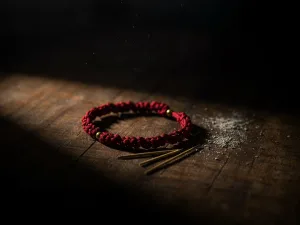
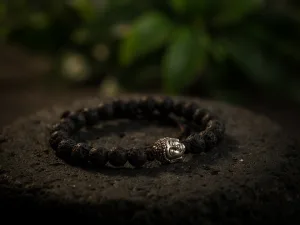
Many traditions have long understood this. A Buddhist counts a mantra on a string of beads. A red thread is tied at the wrist for protection or a new beginning. A few syllables are engraved in silver so they can travel everywhere. The object does not do the work; it reminds you to do it.
Here is a simple practice anyone can use, whatever they believe: choose an intention, set it each morning, and let a piece you wear bring you back to it.
Choosing an intention
An intention is not a goal, or a wish that things will go well. It is a direction for your attention: how you want to meet the day, whatever it brings. “Nothing will go wrong today” is a hope. “I will pause before I answer” is an intention, because it is something you can do.
Keep it short enough to recall in a busy moment. Four that people often return to:
- Calm. “I can slow down.” For the crowded week, the long commute, the evening that needs to end gently.
- Courage. “I can do the hard thing, and do it kindly.” For the exam, the speech, the phone call you have been putting off.
- Gratitude. “I will notice what is already here.” A piece given by someone you love works beautifully for this, because it brings them to mind.
- Care for the people you love. You can also hold others in mind. Buddhist loving-kindness (metta) practice uses simple wishes such as “May you be safe. May you be well.” Say one silently for a partner, child or friend whenever you notice your bracelet.
Choose one intention at a time and keep it for at least a week, so the habit has time to take root. If you would like a stone whose traditional meaning matches it, our guide to choosing a stone by intention is a good place to start, though any piece you love will do.
A two-minute morning practice
An intention sticks best when it is tied to something you already do, and most of us put on jewellery every morning.
- Hold the piece first. Rest it in your open palm. Notice its weight, its temperature, the texture of the beads.
- Take three slow breaths. Let each out-breath be a little longer than the in-breath. You don’t need to empty your mind, only to arrive.
- Say your intention once. Silently or aloud. Mean it, but don’t strain.
- Picture one moment ahead where you will most need it: the ten o’clock meeting, the school run, the drive home.
- Put the piece on. Let the click of the clasp, or the beads sliding over your hand, mark the start.
If you forget one morning, nothing is lost. Put it on with a breath whenever you remember.
A touch and a breath: carrying it through the day
In the Plum Village tradition founded by the Vietnamese Zen teacher Thich Nhat Hanh, the sound of a bell is an invitation to stop, relax and come back to the breath. Practitioners extend the idea to a ringing phone, a clock chime, even a red traffic light. A bracelet can be a silent bell.
Whenever you notice your piece, because it slides down your wrist, catches the light or taps against the desk, pause. Touch it. Take one full breath. Bring your intention to mind.
It helps to add a few anchors: while the kettle boils, before you open your inbox, at the door before you walk into a room.
After a few weeks the bracelet may start to feel invisible. A small change wakes the cue up again: move it to the other wrist for a day, or turn one bead each time you remember.
Counting with a mala: why 108 beads?
Mala is a Sanskrit word meaning garland. A traditional mala, used in Hindu, Buddhist and Jain practice for japa (the repetition of a mantra), has 108 beads plus a larger guru bead, also called the meru or mother bead, which is not counted. You begin beside the guru bead and move one bead for each repetition. When you come round to it again, many practitioners turn the mala and count back the other way rather than crossing over it.
There is no single reason for 108; it has gathered meaning in many places:
- In Buddhism it is often linked to the afflictions of the mind (kleshas). One common explanation multiplies the six senses by three kinds of feeling (pleasant, unpleasant, neutral), by two (in some versions, inner and outer) and by past, present and future: 6 × 3 × 2 × 3 = 108. Versions differ.
- In Japan, many Buddhist temples ring their great bell 108 times on New Year’s Eve. The custom, joya no kane, is said to dispel the 108 worldly desires.
- In Hindu devotion, many deities are honoured with a litany of 108 names, and the Muktika canon lists 108 Upanishads.
Smaller malas are common too, often in counts that divide into 108, such as 54, 27 or 18; four rounds of a 27-bead wrist mala make 108. A full mala can also be wrapped several times around the wrist, like our white bodhi seed mala.
You don’t need a mantra in a language you don’t speak. Many people count breaths instead, one bead for each out-breath, perhaps with a single word such as “calm” or “thank you”.
Left wrist or right? Traditions differ
Confident rules about which wrist to use are easy to find, and many contradict each other. For a mala it depends on the tradition. In Tibetan Buddhist practice the beads are usually counted with the left hand, and a wrist mala is often kept on the left. In Hindu japa the mala is held in the right hand, often with the index finger kept off the beads, since the left hand is traditionally not used for ritual.
Other pieces have customs of their own. A Chinese red string and a Pixiu are both traditionally worn on the left, thought of as the receiving side; our guides to the red string bracelet and the Pixiu explain why, and where other traditions differ.
If you follow a teacher or tradition, follow their guidance. If not, choose the wrist where you will notice the piece most; for many people that is the non-dominant hand, where it is safer from knocks. The intention matters more than the side.
Keeping the meaning fresh
A few habits keep the meaning alive:
- Take it off with care. At night, set the piece somewhere deliberate: a small dish by the bed, or a shelf or home altar. Many Buddhist practitioners keep malas off the floor out of respect, a good habit for any piece that carries meaning.
- Review once a week. Does the intention still fit? When it has done its work, choose a new one on purpose, perhaps at a birthday or a new year.
- Let it show its age. Many wood and seed beads darken with handling, and copper takes on a patina. In time the piece becomes a record of every moment you reached for it.
A journaling prompt for the week
Each evening, write a few lines in answer to these:
- When did I remember my intention today, and what was happening?
- When did I forget it, and what pulled me away?
- Where is one moment tomorrow that I would like to remember it?
After a week, read it all back; the patterns often say more than any single day.
Frequently asked questions
Do I need to be Buddhist to wear a mala?
No. People of many faiths, and of none, use malas as meditation tools and reminders. For many people they remain religious objects, so treat yours with respect and learn a little about where it comes from.
How long should I keep the same intention?
A week is a good minimum, so the reminder has time to become a habit. Some people keep one intention for a whole season; others choose a new one each month. Change it when it stops feeling alive, not because a set time has passed.
What if I keep forgetting my intention?
That is normal, and the returning is the practice. In meditation, noticing that the mind has wandered and coming back is the exercise itself. Each time you remember, you have done it.
Any piece you love can carry an intention, including one you already own. If you would like something new for this kind of practice, our Calm & Balance collection gathers malas, sandalwood and other pieces worn for steadiness.
Share this article
Shop the meaning
Wear what it means to you
Every piece in our collections is sorted by the intention, symbol and stone it carries, with the meaning explained in plain words.
Keep Reading

Meanings & Symbols
Stones & Materials
Stones & Materials